Polymerase Chain Reaction (PCR)
Polymerase Chain Reaction (PCR)
The Polymerase Chain Reaction (PCR) is a laboratory (in vitro) technique for generating large quantities of a specified DNA. Obviously, PCR is a cell-free amplification technique for synthesizing multiple identical copies (billions) of any DNA of interest. Developed in 1984 by Kary Mullis (Nobel Prize, 1993), PCR is now considered as a basic tool for the molecular biologist. As is a photocopier a basic requirement in an office, so is the PCR machine in a molecular biology laboratory.
Principle of PCR
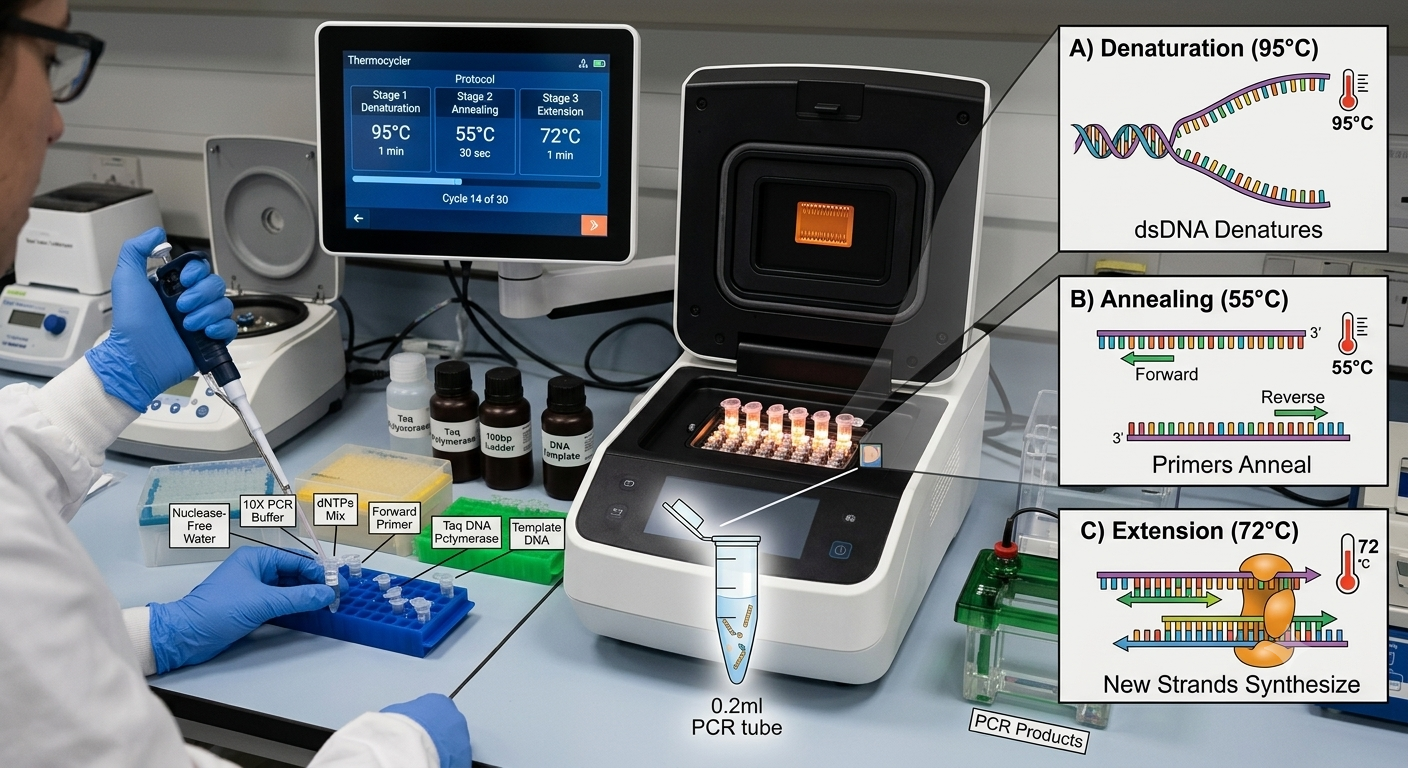
The double-stranded DNA of interest is denatured to separate into two individual strands. Each strand is then allowed to hybridize with a primer (renaturation). The primer-template duplex is used for DNA synthesis (the enzyme DNA polymerase). These three steps—denaturation, renaturation, and synthesis—are repeated again and again to generate multiple copies of target DNA.
Technique of PCR
The essential requirements for PCR are listed below:
- Target DNA: (100 – 35000 bp in length).
- Two Primers: Synthetic oligonucleotides of 17-30 nucleotides length that are complementary to regions flanking the target DNA.
- Four Deoxyribonucleotides: dATP, dCTP, dGTP, dTTP.
- DNA Polymerase: A DNA polymerase that can withstand up to 95 degree (i.e., thermostable).
Each cycle has three stages:
- Denaturation: By raising the temperature to about 95 degree for about one minute, the DNA gets denatured and two strands separate.
- Renaturation (Annealing): As the temperature of the mixture is slowly cooled to about 55 degree, the primers base pair with the complementary regions flanking target DNA strands. This process is called renaturation or annealing.
- Synthesis (Extension): Typically at about 70-75 degree.
These three steps constitute the one cycle of the PCR amplification and can be carried out just by the changing the temperature of the reaction mixture. The thermostability of the polymerase makes it feasible to carry out PCR. Suitable heat-stable DNA polymerases have been obtained from microorganisms whose natural habitat is hot spring springs. The widely used Taq DNA polymerase is obtained from Thermus aquaticus and is thermostable up to 94 degree. Other thermostable DNA polymerase currently used in PCR are Pfu (Pyrococcus furiosus).
After each cycle, the number of templates doubles, so that if one starts with a single double-stranded DNA molecule, after 20 cycles, the number of molecules synthesized by the PCR.
Please buy a good book of Polymerase Chain Reaction….below link book provided….and you can manually search