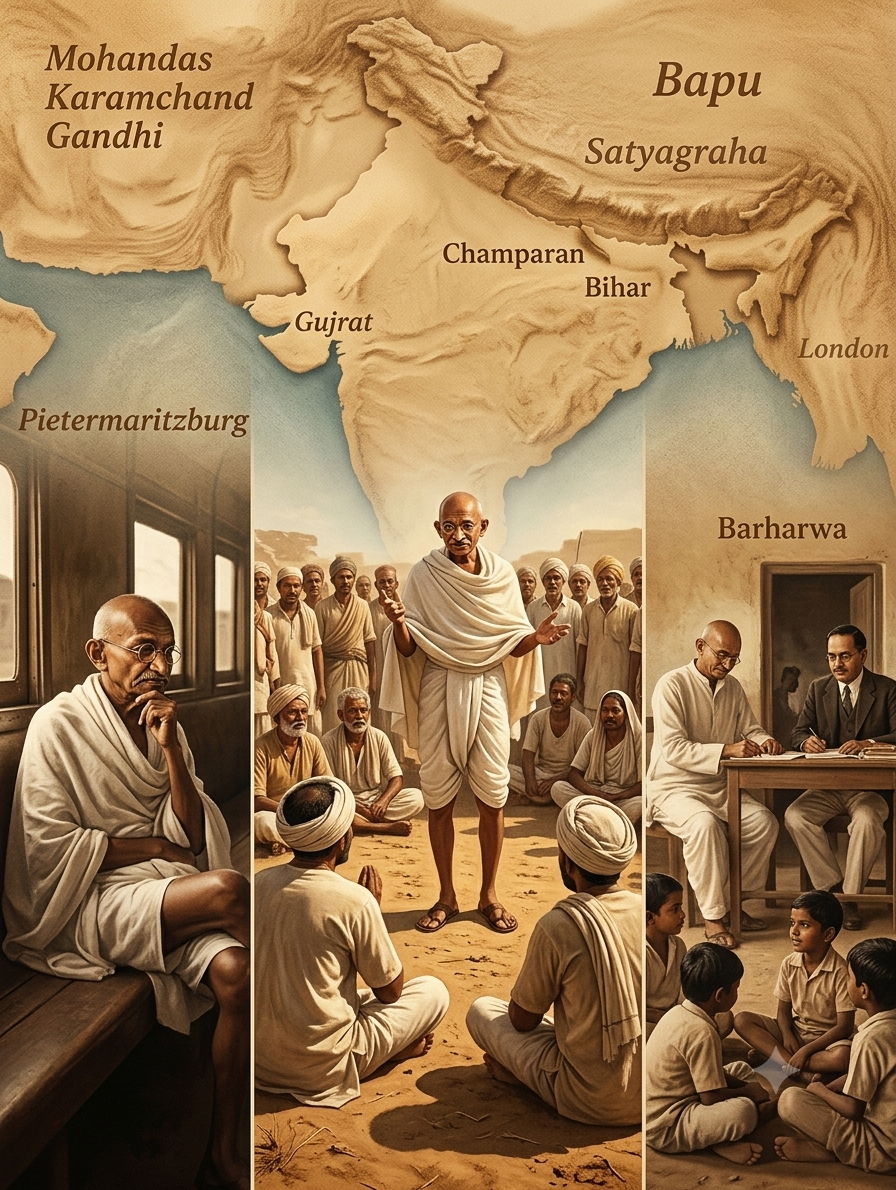
Life Story of Gandhi
Mohandas Karamchand Gandhi was born on 2 October 1869 at Porbandar. Mohandas Karamchand Gandhi was called “Mahatma”. His father name is Karamchand Uttamchand Gandhi, who served as the chief minister of Porbandar state.
His mother name is Putlibai Gandhi, who was a devoted practitioner of Vaishnavism.
Porbandar is a city in the Indian state of Gujrat. Porbandar is the birthplace of Mahatma Gandhi. Every year, on 2 October, Gandhi Jayanti is observed.
At the age of 11, Mahatma Gandhi went to high school at Rajkot. At the age of 13, Mahatma Gandhi was married to Kasturba. Mahatma Gandhi had four sons, namely Harilal, Manilal, Ramdas, and Devdas. In 1888, he joined Samaldas College in Bhavnagar at Gujrat.
However, he was encouraged to go to London to study law. He joined the University College London (UCL).
In 1887, he passed the matriculation examination from Bombay University.
After completion of law degree, he came back to home.
In 1885, his father was died. In 1891, he returned to India and got involved the lawyer profession in Rajkot and Mumbai.
Mahatma Gandhi is popularly known as Bapu. He was a great man. He was Indian lawyer, political, social activist, and writer.
Gandhiji in South Africa:-
Gandhiji traveled to South Africa in 1893 to practice law. He spent 21 years in South Africa. Mahatma Gandhi travelled in railway first class coach. When one white man objected to this, he throw off a train at the Pietermaritzburg railway station. Gandhiji later wrote: –
“I was afraid for my very life. I entered the dark waiting-room. There was a white man in the room. I was afraid of him. What was my duty? I asked myself. Should I go back to India, or should I go forward with God as my helper and face whatever was in store for me? I decided to stay and suffer. My active non-violence began from that date.”
Gandhiji returned to India in 1915.
In which time, In 1893, Dada Abdullah was a large successful shipping business in South Africa. Dada Abdullah cousin in Johannesburg needed a lawyer. Then Dada Abdullah contacted Gandhi.
Champaran Satyagraha
The first satyagraha movement led by Gandhi in 1917. Champaran is a region which located in Bihar, India. In April 1917, Champaran Satyagraha held in Motihari, Bihar.
Before Champaran Satyagraha, the farmer of Champaran were cultivated indigo in five katthas of land in a bigha. This system is known as “panchkathiya” system. The local leaders like Seikh Gulab, Harbans Sahay, Pir Mohammed Munsi, Sant Ravat and Lomrah Singh agitate against the “panchkathiya system”. They removed the “panchkathiya” system. Then, the farmer of Champaran used to follow the “tinkathiya” system, whereby three katthas of land in a bigha had to be planted with indigo. Indigo is a cash crop and used to make dye.
In the Champaran district of Bihar, the farmers were forced by Europeans to grow indigo. Farmers could not agree to grow indigo and did not receive adequate payments for the indigo.
Raj Kumar Shukla was not happy with this obnoxious system of agriculture. Brajkishore Prasad and Rajendra Prasad (lawyer of Patna) suggest him to meet Mohandas Karamchand Gandhi.
Champaran Satyagraha
- When Gandhi was attending the 31st session of the Congress in Lucknow and he did not have time to go Champaran.
- Shukla met him Gandhi.
- Raj Kumar Shukla requested him to come and help the suffering farmers in Champaran. Gandhi promised him to visit Champaran. Therefore, Gandhi arrived in Champaran 10 April 1917. Gandhi stayed at the house of Sant Raut in Amolwa village with a team of eminent lawyers like Brajkishore Prasad, Rajendra Prasad, Anugrah Narayan Sinha, Ramnavmi Prasad, and J.B. Kripalani.
- When he reached the Champaran district of Bihar, the District Magistrate served him with a notice saying that he must leave the place by first available train. Gandhi disobeyed this order. He said, “I came here to render humanitarian and national service. I shall make Champaran my home and work for the suffering people.” The Government withdrew the case against Gandhi. Then Gandhi stayed in the village and visited many villages.
- When Gandhi reached Champaran, the District Magistrate ordered him to leave Champaran. Gandhi refused his order and was summoned to court. Gandhi appeared in court without a pleader. The court resolved this problem and said not to leave Champaran.
Salt Satyagraha
- The Salt March is also known as Salt Satyagraha, Dandi March, and Dandi Satyagraha.
- The Salt Satyagraha was a nonviolent civil disobedience movement in India led by Mahatma Gandhi.
- The Salt Satyagraha happened in March – April 1930.
Kheda Satyagraha
- Kheda is also known as Kaira. Kheda is located in the Indian state of Gujarat.
- Kheda Satyagraha was held in the Kheda district of Gujarat, India. The Kheda Satyagraha movement was led by Mohandas Karamchand Gandhi in 1918. The major leaders were Mohandas Karamchand Gandhi and Sardar Vallabhbhai Patel.
- In Kheda district lived the peasant-Patidar community. Famine had arisen in the Kheda district. This region also had an outbreak of cholera and plague. Due to drought, the farmers failed to produce crops. So, this region was affected by famine, cholera, and plague, destroying the agrarian economy.
- The Bombay Presidency had increased the taxes in 1917–1918 by 23%. Farmers were unable to pay this tax due to the cholera outbreak, and many persons died in the famine. But the Government refused to suspend the collection of land revenue. The Government said if the taxes are not paid, the property would be seized.
- Then Sardar Vallabhbhai Patel, under the guidance of Mohandas Karamchand Gandhi and many farmers, protested against the collection of tax.
- In 1918, Gujarat as a whole suffered from plague, and in Kheda alone around 17,000 people lost their lives.
- The major leaders included Sardar Vallabhbhai Patel and his colleagues such as Narhari Parikh, Mohanlal Pandya, Ravi Shankar Vyas, Indulal Yagnik, Shankarlal Banker, and Mahadev Desai.
- Finally, the authorities gave some concessions to the farmers.
Ahmedabad Mill Strike
- Ahmedabad was the second largest city of Bombay Presidency and an industrial town of the 20th century. Ahmedabad is located in the Indian state of Gujarat and is known as the “Manchester of India.”
- Ahmedabad was the second largest production centre of cotton textiles, employing 40,000 workers.
- The Ahmedabad Mill Strike happened during February – March 1918. This strike movement was led by Gandhi.
- Due to an outbreak of plague, the mill workers began leaving the place. To retain them during the plague, the mill owners paid a 75% bonus. But after the plague was over, the mill owners stopped the bonus. The workers were demanding a 50% bonus.
- Gandhi supported the mill workers upon an invitation by Anusuya Sarabhai and her brother Ambalal Sarabhai. The workers went on strike and demanded a 35% increase in wages.
- The strike was successful; they finally agreed to a 35% pay rise.
Gandhi was interested in becoming a doctor. He was born in Gujarati Modh Bania family of Vaishya caste. Porbandar is a small town on the western coast of India. In seven years old, his family moved to Rajkot. He was a “mediocre student”.
In 4th September 1888, Gandhiji go to London from Bombay on the SS Clyde. He reached to London in three weeks. In 1888, approximately six million population lived in London.
Before leaving for London, he had promised his mother not touch to meat, alcohol and foreign women.
Before leaving for London, he carried homemade Gujarati sweets and ganthias. When reached to London he found the climate of England “cold and invigorating”. He was an average student, and was called to the Bar in 1891.
His eldest brother and family friend suggest that Gandhi to go to London for studying law. But his mother did not like the idea of his going to England. Mavji Dave Joshiji a Brahmin priest.
In July 1888, his wife Kasturba gave birth to his first child. His first child name was Harilal.
Gandhi enrolled in the High Court of London, but later he left to India.
Gandhi was a young Indian lawyer, born in India and educated in London. He travelled to South Africa in 1893 to practice law under a one-year contract. He was removed from a first-class railway compartment. He decided to fight injustice.
When his contract expired, he decided to live in South Africa. He formed the Natal Indian Congress in 1894. This organisation aimed to fight discrimination against Indians in South Africa.
The Natal Indian Ambulance Corps was created by Gandhi during the outbreak of Second Boer War in 1899. Gandhi gathered 1100 local white men, Indians.
Indigo is a cash crop and which needed high amounts of water and which left the soil fertile. The Champaran of farmers usually opposed its cultivation; they prefer to cultivate rice and pulses.
He establish the first-ever basic school at Barharwa Lakhansen village on November 13, 1917. Bharharwa Lakhansen village was located at Dhaka, East Champaran. He also set up two more basic schools at Bhitiharwa in West Champaran and Madhuban in this district on November 30, 1917 and January 17, 1918 respectively. He set up school to improve the economic and educational conditions of the people. In which time, Gandhi called Bapu (Father) by Sant Raut.
In 4th March 1918, Governor General of India signed on agrarian bill and abolished the “tinkathiya” system. In 1st May 1918, Governor General finally signed the Act and thus the end of “NEEL KA ABHISAP”.
Under the pressure from the Government of India, Government of Bihar set up a committee of Inquiry. This committee implemented by the Champaran Agrarian Act of 1917.
Champaran Satyagraha
Champaran is a district in Bihar. In 1972, it was divided in two districts, namely West and East Champaran.
Champaran Satyagraha is also known as the Indigo revolution. Many indigo factories were established in Champaran along the banks of Gandak river.
Lastly, he was eventually put in prison. Rajendra Prasad and Maulana Mazharul Haque, came to meet Gandhi in jail. The next evening, Sir Edward Gait send message to District Magistrate to withdraw his case immediately. Then, he release from jail. The government was forced to appoint an Enquiry committee in June 1917 with Gandhi as a member.
Raj Kumar Shukla was an indigo cultivator.