Escherichia coli: Characteristics, Structure, Pathogenicity and Applications
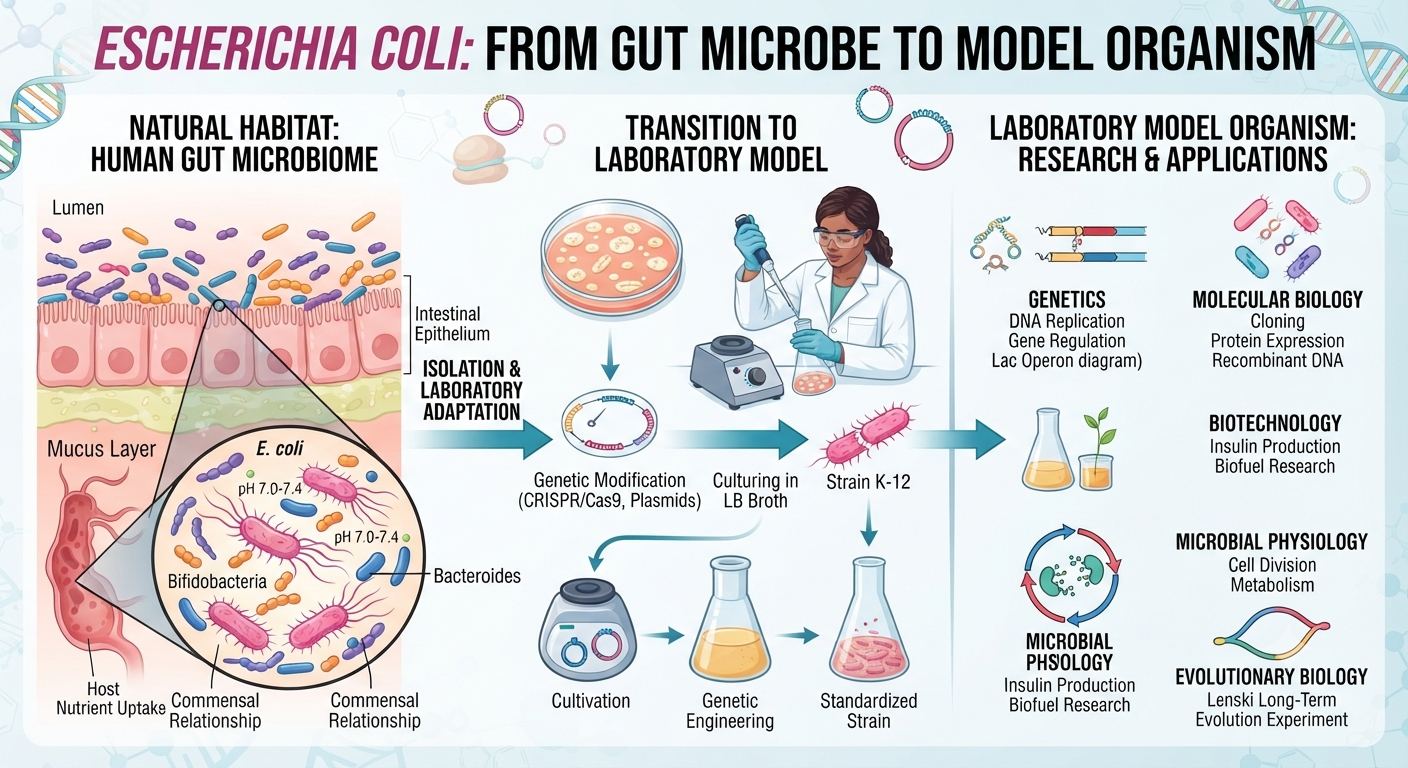
Escherichia coli: From Gut Microbe to Model Organism
E.coli is a gram negative, facultative anaerobic, rod shaped and nonsporulating coliform
bacteria that belongs to the Enterobacteriaceae family. In 1884, the German microbiologist
and pediatrician Theodor Escherichia began a study of infant gut microbes. During his study,
he discovered a first growing bacterium that he called bacterium coli commune because it is
found in the colon, which is now known as Escherichia coli. E.coli is a circular DNA
molecules 4.6 million base pairs in length. E.coli is found in air, water, soli, vegetables, and
food. E.coli is also found digestive tract and gut of humans. E.coli bacteria normally live in
the intestines of healthy person. Cells are about 2.0 micrometer long and 0.25-1.0 micrometer
in diameter. E.coli can transmitted from person to person. E.coli is the most widely studied
prokaryotic model organism. It is also used in the fields of biotechnology and microbiology.
Most strains of E.coli are harmless. Some other strains of E.coli make people sick. E.coli
strains 0157: H7 produce a toxin called shiga toxins and are called “Shiga toxin producing
E.coli (STEC)”. E.coli is infection of the urinary tract and bladder. E.coli is able to grow in a
rich medium such as Luria-Bertani broth, or on rich media agar plates. Optimum groeth of
E.coli occurs at 37℃ under aerobic conditions. Scientists use E.coli to store DNA sequences
other organisms to produce proteins. Scientists use E.coli because it was easy and first to
grow in the laboratory. E.coli helps digest the food.
Most strains of E.coli can cause illness in humans including diarrhea, abdominal pain, fever,
and sometimes vomiting. E.coli strains 0157:H7 is one of the most powerful toxins, and it can
cause an intestinial infection. Signs and symptoms of E.coli strains 0157:H7 infection
including Diarrhea, Stomach, Nausea, and vomiting. Six different strains of E.coli like Shiga
toxin producing E.coli (STEC), Enterotoxigenic E.coli (ETEC), Enteroaggregative E.coli
(EIEC), Enteropathogenic E.coli (EPIC), and Diffusely adherent E.coli (DAEC) are known to
cause diarrhea. E.coli can have the following symptoms like stomach pains and cramps,
fatigue, loss of apetite, and low fever.